
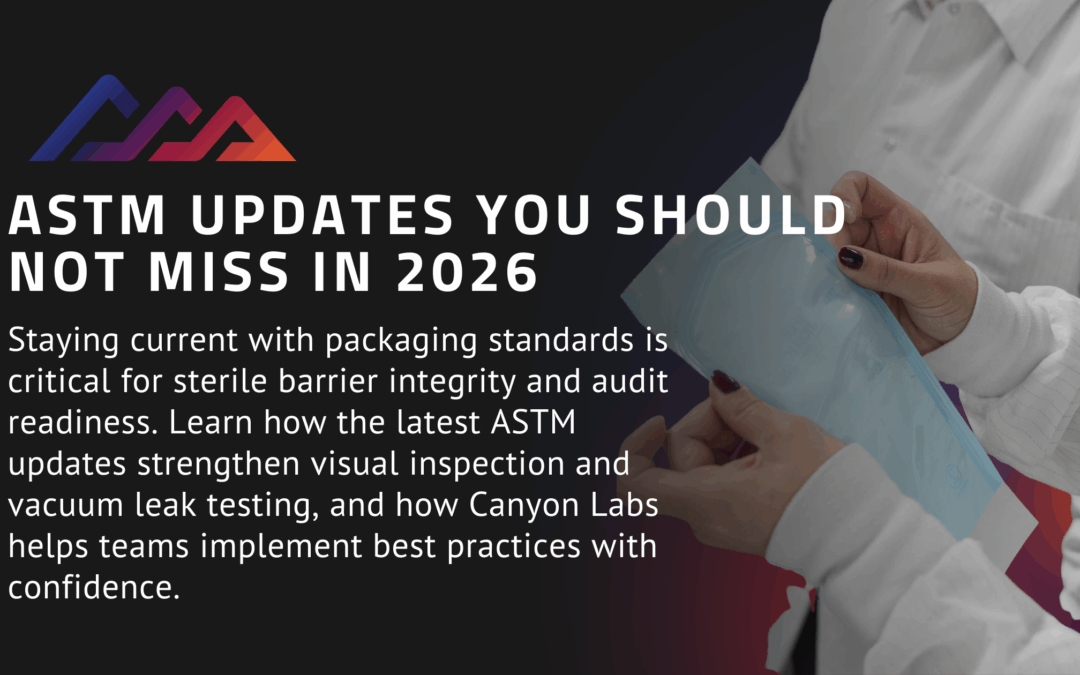
Staying current with packaging standards is essential for keeping sterile barrier integrity rock-solid and audit ready. Two recent updates are essential for anyone working with medical device packaging: ASTM F1886/F1886 M25 (visual inspection) and ASTM D4991-25 (vacuum leak testing of empty rigid containers). Canyon Labs contributed to the rewriting of both standards, ensuring the updated guidance reflects best practices for visual inspection and vacuum leak testing.
ASTM F1886/F1886 M25: Visual Inspection Update
This standard has been restructured into two parts to clarify scope and strengthen guidance beyond seals:
Part 1: Inspection of Seals This section remains fundamentally unchanged. It focuses on detecting channels and visual defects in peelable and nonpeelable seals, retaining the prior precision and bias.
Part 2: Inspection of Material Surfaces (New) This revision introduces a dedicated section for package surface inspection, separating it from seal inspection for greater clarity. Previously, all visual criteria were grouped together. Now, the inspection criteria explicitly include the entire package, both transparent and opaque surfaces, in addition to seals (Part 1).
Because this is new territory, Canyon Labs plans to perform a Test Method Validation (TMV) to define detectable defect sizes and demonstrate technician proficiency for the defects beyond the seal. Note: precision and bias data are still in the works, with a laboratory round table to be executed in the future.
Appendices
The appendices were altered by dividing the information into two groups. Appendix X1 covers the seal area, while Appendix X2 captures the package surface. More notably these appendices include clearer definitions of defects and pictures to provide specific visuals depictions to users.
Why it matters: ASTM F1886/F1886 M25 formalizes the practice of visually inspecting a package beyond the seal area. This update reduces the risk of undetected integrity issues, aligns with standards like ISO 11607 which emphasize sterile barrier integrity across the whole package, and, by demonstrating due diligence, improves your readiness for audits and investigations.
ASTM D4991-25: Vacuum Leak Testing of Empty Rigid Containers Update
A minor but meaningful revision in the 2025 update of ASTM D4991, method for vacuum-based leakage testing of empty rigid containers, makes a small wording change that can improve consistency.
Updated Immersion Depth Requirement In Section 6.4, the standard now specifies that test specimens must be positioned “no less than one inch below the surface” of the test fluid, replacing the older phrasing, “no more than one inch under the surface.”
Why it matters: This update ensures consistent placement of specimens in the test chamber, reducing variation in vacuum exposure conditions.
Canyon Labs is fully aware of these ASTM updates and ready to support your team with expert guidance, validation strategies, and implementation best practices to keep your packaging processes compliant and audit ready.